

The Long Game: What Building A Personal Brand Actually Takes
A phase-by-phase guide to how personal brand building actually works

Nobody starts building a personal brand thinking it’ll take years.
They think: maybe a few months? A good headshot. A bio that finally sounds like them. A few posts, a little consistency, and then the fire ignites. The followership scales.
My secondborn had a significant speech delay. He was a COVID baby—raised in a world that was a little quieter, family at a distance, less freedom to explore and surround ourselves with the community so important for growth in those early years.
I did everything they recommended. Speech therapy. Preschool enrollment so he could be surrounded by peers daily. Books, courses, learning tools, a trip to the ear doctor—all in the hope of finding the answer. Of spurring that momentum. Of helping him find his voice.
By three, he still had an extremely minimal collection of words he was using to express his wants and needs.
I still remember the specific weight of that silence. The way it pressed on everything. I blamed myself the way mothers do—quietly, completely, in the margins of every ordinary day. Too much screen time while balancing pandemic life and two boys. The comparison trap at the playground, watching kids his age speak in full sentences. The weight of being seen as “shy.” How I wanted him to find community, confidence, a voice that felt like his own.
What I didn’t know then—what I couldn’t have known—was that he was building something. Quietly. In his own time. On a timeline that had nothing to do with the one I’d invented for him.
We always knew he understood. We’d ask him to get his pajamas and he’d go get them without hesitation. And magic moments would creep in. One I still remember: my husband holding him at a home goods store, moving through a display of area rugs, asking him the color of each one. And to our complete surprise, he named every single one. Fleeting proof, offered quietly, from inside his silent world.
Then he hit the milestone. A switch turned on.
He talks now. Literally all the time. It never stops. He is a full-on social butterfly— making friends at every playground, surprising us constantly with the words he knows, the sentences he builds, the confidence he carries. The thing I yearned for became the thing I can’t imagine living without.
I’ve been thinking about his long game a lot lately. And I keep making the same mistake I made with him—measuring progress on a timeline I invented, and calling it failure when the timeline turns out to be wrong.
Here’s what I’ve learned about the long game. From him. From seven years building other people’s brands before I built my own. And from the quiet, stubborn, imperfect practice of finally showing up for myself.
01—THE TRAP Why most people quit their personal brand too soon
The trap isn’t laziness. It isn’t a lack of talent or consistency or good ideas. The trap is a timeline mismatch—expecting social media speed from a process that runs on compounding interest.
You post for six weeks. You watch the numbers. The numbers don’t move the way you hoped. You decide it’s not working. You stop.
But here’s the thing about compounding interest: it looks like nothing for a very long time. And then it looks like everything. The problem is you can’t see the inflection point coming—you can only see it in the rearview mirror.
The hardest part of the long game isn’t the effort. It’s the patience. And we are—most of us—spectacularly bad at patience when it comes to ourselves.
We give our plants time to root. We give the sourdough starter three days to come alive. But we give ourselves six weeks and call it quits.
The long game has phases. And the reason most people stall is that they treat all three phases the same…same expectations, same metrics, same definition of success. Here’s what the phases actually look like.
02—THE PHASES The three stages of personal brand growth
There are three phases to building a personal brand. Every person who has ever built something real has moved through all three. The timelines vary. The phases don’t.
The phase you’re in determines everything—what you should measure, what you should ignore, and what you should absolutely not do yet. Here’s the specific playbook for each one.
📋 FREE RESOURCE FOR SUBSCRIBERS
The Long Game Timeline
A one-page visual guide to every phase of building your personal brand—what to focus on, what the signs of progress actually look like, and what not to do yet. Because knowing which phase you’re in changes everything.
🌱 Plant · 🌿 Tend · 🌾 Harvest · 3 focus areas · data benchmarks · signs you’re on track · action steps
↓ Download free below—included with this issue.
03—THE PLAYBOOK What to do at each stage of building your personal brand
This is the part I wish someone had handed me. Not the vague advice… “be consistent, show up, add value.” The specific moves. The things that actually matter in each phase, and the things that are a waste of your energy right now.
🌱 IF YOU’RE IN PHASE 1 — PLANT
Pick two platforms maximum. You cannot be everywhere and build anything worth reading. LinkedIn and Substack. Instagram and Substack. Pick your two and go deep.
Publish before you’re ready. The first 20 pieces are practice. They are supposed to be imperfect. Publish them anyway—you cannot edit your way to a voice, you have to write your way there.
Don’t measure followers. Measure clarity. After every piece you publish, ask: am I getting sharper about what I stand for? That’s the only metric that matters in Phase 1.
Give yourself a 90-day runway before evaluating anything. 90 days. Not six weeks. Not one bad month. 90 days of consistent effort before you draw any conclusions.
Find one creator whose work you genuinely admire and study their structure—not their topics, not their aesthetic. How do they open? How do they close? How do they move from personal to practical?
🌿 IF YOU’RE IN PHASE 2 — TEND
Look at your last 10 pieces and find the 2 that resonated most. What do they have in common—the topic, the tone, the vulnerability level? Do more of exactly that.
Start building a resource. Even one PDF. Even a simple checklist. Products signal to your audience that you’re serious. They also signal it to you.
Engage more than you post. Leave comments with the depth of a full post. That’s how people find you—not through your content alone, but through who you are in other people’s conversations.
Start collecting the exact phrases your audience uses in comments and DMs. That’s your next six months of content, in their own words.
Pick one metric and care only about that. Open rate. Click rate. New subscribers. One. The one that maps to your actual goal right now.
🌾 IF YOU’RE IN PHASE 3 — HARVEST
Systematize before you scale. A scrappy system you actually use beats a perfect system you’re still building. Document what’s working before you try to do more of it.
Start saying no. Not every opportunity that arrives with your visibility is the right one. The long game gave you the ability to choose. Use it.
Invest in your Phase 1 people…the readers who were there before it was working. They are your community. Treat them like it.
Build your flagship piece. One article, one resource, one post that new people find first. Your best work, deliberately positioned as the front door.
Teach someone else what you’ve learned. That’s how you know you’ve actually learned it, and it’s how the long game compounds beyond you.
04—THE PERMISSION SLIP A permission slip for anyone building a personal brand in the quiet phases
If you’re in Phase 1 and you’re about to quit, I need you to stay with me for one more minute.
You have never once questioned whether parenthood was worth it during a hard week. You have never decided to stop being a mother, a father, because the results weren’t coming fast enough. You didn’t pull back your investment when the timeline got longer than you expected.
Your brand deserves that same faith. Not because it’s as important as your children—it isn’t, nothing is. But because you are worth the same patience you give everyone you love.
Phase 1 doesn’t look like building. It looks like nobody cares. It looks like you’re talking to yourself. It looks like it isn’t working. It is often silent with fleeting moments of magic.
Keep going anyway.
The invisible phase is not a sign that you’re doing it wrong. It’s a sign that you’re doing it right—that you’re planting something real, something rooted, something that doesn’t blow over the first time the wind picks up.
He talks now.
He talks so much that some nights I ask him, gently, to give me just five minutes of quiet. And then I sit in those five minutes feeling slightly guilty for asking, because I remember.
That’s the long game. You can’t see it working. And then one day you look up and realize. Wow, it worked. You’re just living inside it now.
You’re in Phase 1 of something that will change everything. Or Phase 2, adjusting and listening and trusting. Or Phase 3, finally watching what you planted come in.
Whatever phase you’re in, stay. It’s going somewhere.
See you next week—still in the game, still building, still human. 🤍
FREE RESOURCE
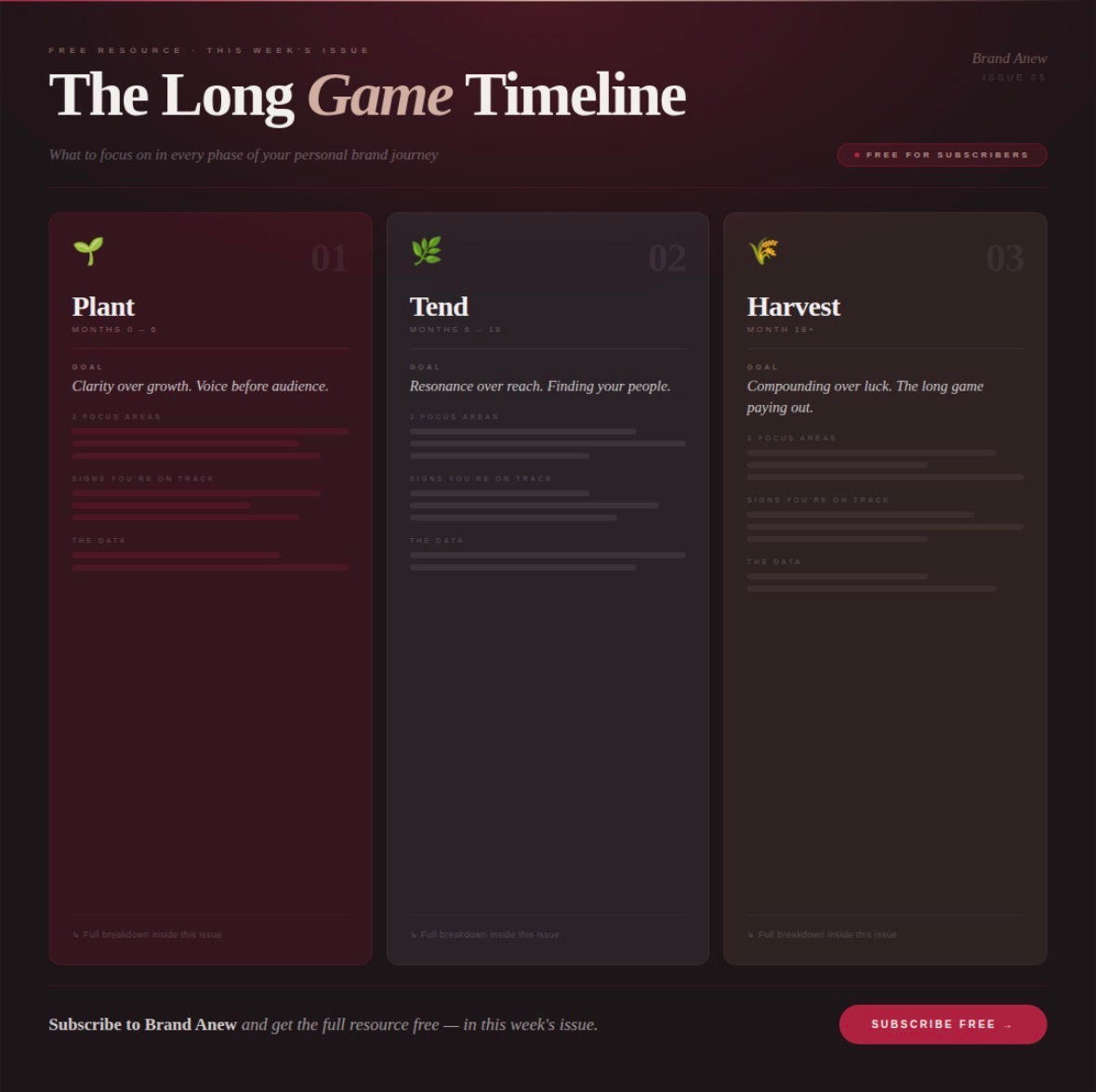
Download The Long Game Timeline—a one-page visual guide to what to focus on in each phase of your personal brand journey. Because knowing which phase you’re in changes everything.
Download Here
Enjoying Brand ANews? The Thought Leadership Starter Kit helps you show up and sound like yourself—in 90 minutes, one sitting.