

Visibility Changes How Opportunities Find You
The subtle shift from chasing work to attracting aligned conversations.

There’s a particular kind of tired that comes from chasing. You write the pitch, you tailor the proposal, you follow up twice and decide the third time would read as desperate. The work, when it lands, feels earned the way a long shift feels earned. You did everything right and you are so wrung out.
Then something changes, and you feel it before you can explain it. A message arrives from someone you never pursued. They reference a thing you wrote months ago. They already know what you do, and they aren’t asking you to prove it. The conversation opens three steps ahead of where your pitches used to start. You do a happy dance.
That is what visibility actually does. It does not make you louder. It changes the direction opportunity travels.
The Tired That Comes From Chasing
When no one can see your expertise from the outside, you have to carry it to them. Every opportunity becomes something you go and get. You are the one initiating, explaining, qualifying yourself at the door of every conversation. It works, in the way that effort always works. It just never compounds, because the moment you stop pushing, the pipeline goes quiet.
Most people read this as a volume problem and respond with more, more, more. Double the posts and be everywhere at once. But the people who get found are not the loudest. They are the most legible. Read them once and you know what they do and who they do it for. That is what turns a stranger into a customer.
What Visibility Actually Reroutes
You plant a point of view in public. You tend it long enough that it starts to hold a shape. And somewhere in the tending, the work flips direction. The expertise you used to deliver person by person now arrives ahead of you, doing the introductions you used to do yourself.
You stop convincing people you’re worth a conversation and start having the conversation.
This is the part the chasing years never tell you. The harvest does not look like a flood of leads. It looks like better questions landing in your inbox from people who already understand the answer you give.
Where Discovery Actually Happens
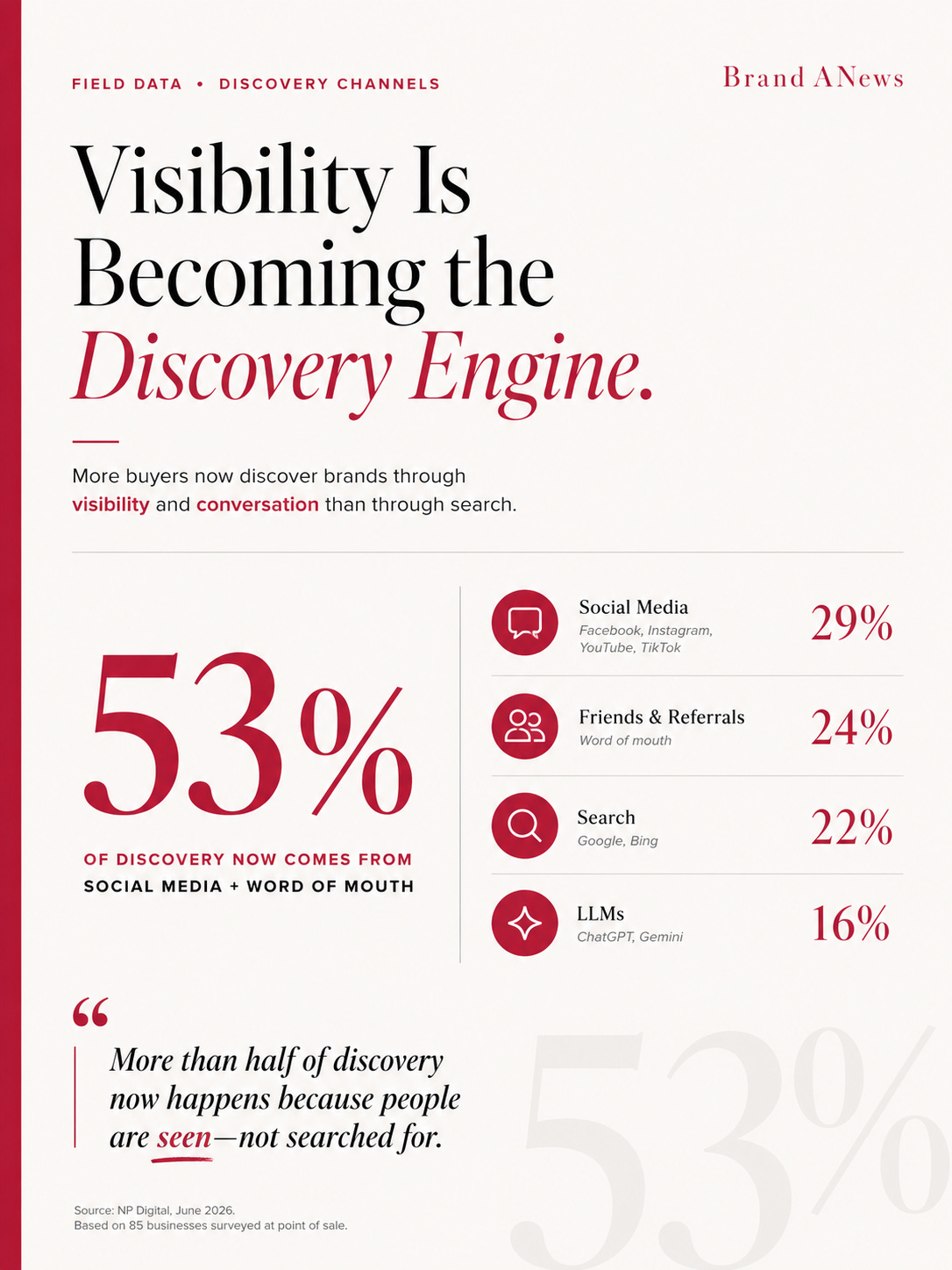
Neil Patel’s team ran a small, honest experiment. They had eighty-five companies ask new customers one question right after the sale: how did you first hear about us. Not how people claim they research. How they actually found them.
Social media came first, at twenty-nine percent. Friends came second, at twenty-four. Traditional search, the line most budgets still fund before anything else, came third at twenty-two. AI tools like ChatGPT and Gemini already account for sixteen percent of how buyers turn something up, ahead of communities and review sites combined.
Put the top two together and more than half of all discovery now runs through being seen and being talked about. Not searched for. Seen. The brands people find are the ones already moving through the feed and the conversation before anyone goes looking. Search is where someone confirms a name they half-recognize. Visibility is where the name gets planted.
Once they find you, your published expertise does the rest. Across years of Edelman and LinkedIn’s research, about three in four decision-makers say a piece of thought leadership led them to consider something they hadn’t before.
Aligned Is the Whole Point
More attention is not the win. Anyone can manufacture more attention. The shift that matters is in the kind of conversation that starts finding you.
When you are visible in one specific direction, you attract people moving in that same direction. The lane does the filtering. A founder who writes consistently about human-first brand building does not get random inquiries. They get the right ones, from people who read three pieces before reaching out and arrive already convinced of the premise. The work of persuasion happened before the conversation, in public, on your terms.
Ieva Drazniece, who writes Amateur Human Being and coaches people on building confident thought leadership on LinkedIn, named this better than I can. A cybersecurity keynote invitation reached her not from a pitch but because she’d been sharing unpolished morning videos, trucker hat and all, and the people on the other end of that recognized her. The way she put it:
Without you showing up first, there is no room for proof.
The proof you are waiting for, the referral, the invitation, the note from a stranger, cannot find you until there is something of yours already in the open for it to land on.
What To Plant This Week
Not everyone reading this has had work start finding them yet. Lia, who writes Ad Psychology, wrote back so authentically when I asked her to weigh she shared that she was “still in the phase of building visibility.”
What she has noticed instead is quieter. “Publishing changes how you think,” she wrote. Before she shared her ideas publicly, “everything stayed in my head.” Writing consistently, she said, “has forced me to clarify my perspective and put my expertise into words.”
She isn’t pretending the opportunities have flooded in. “I may not be seeing a flood of opportunities yet, but I can see how visibility is creating a foundation.”
“People can’t find what they can’t see.”
That is the return before the return. Articulating what you know sharpens what you know, and the roots needs time to grow before the harvest arrives.
None of this asks you to be everywhere. It asks you to be findable in one direction, on purpose.
Name your lane in a single plain sentence, the kind a stranger could repeat to someone else without your help. If you cannot say it in one line, no algorithm and no reader is going to do that work for you.
Take one thing you know cold and translate it for someone outside your field. Not a credential, not a service description. One idea, written so a person who has never met you walks away understanding how you think.
Plant the point of view, tend it past the part where most people quit, and let the harvest reroute itself toward you.
You spent years getting good enough to be chosen. Visibility is how you stop waiting to be.
— Nat
The conversations you want are already happening. Right now, they are finding someone more visible than you, not because they know more, but because they are easier to find. A 1:1 Visibility Strategy Session is where we build the lane that changes that, so the next aligned conversation has somewhere to land. That session is the deeper room. If you’d rather start on your own first, the Thought Leadership Starter Kit gives you the strategy in one sitting, in your own voice.
Continue Reading

Some People Will Only Respect You Once Strangers Do

There’s a moment that happens quietly, somewhere in the middle of building in public, where you look around and realize the room has changed. Not all at once or dramatically. But the people reaching …
The Long Game: What Building A Personal Brand Actually Takes

Nobody starts building a personal brand thinking it’ll take years.
I've noticed that many people assume visibility is about being seen.
What it actually seems to create is familiarity.
The more consistently people encounter your ideas and perspective, the less they feel like they're meeting a stranger when an opportunity finally arises.